Barnes & Noble Will Not Stock Titles Published by Amazon – Publisher’s Weekly
THIS JUST IN. Short, sweet, to the point.

Barnes & Noble Will Not Stock Titles Published by Amazon – Publisher’s Weekly
THIS JUST IN. Short, sweet, to the point.
I Know Why the Caged Bird Sings by Maya Angelou 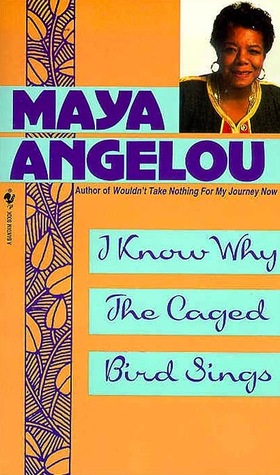
A phenomenal #1 bestseller that has appeared on the New York Times bestseller list for nearly three years, this memoir traces Maya Angelou’s childhood in a small, rural community during the 1930s. Filled with images and recollections that point to the dignity and courage of black men and women, Angelou paints a sometimes disquieting, but always affecting picture of the people—and the times—that touched her life.
I had to read this for my advanced nonfiction writing course, and my peers were surprised when I said I had not read it before. Apparently it’s assigned a lot in high school English classes. My high school, though extremely academic and well-educated, was a bit biased and stuck underneath a bubble. It’s a predominately white, rich community, and in no way intended to create a curriculum that was – by not having black literature – racist. What wasn’t there or didn’t happen in this community, wasn’t or wouldn’t be acknowledged. I didn’t realize how sheltered it was until I came to college.
That said, all I knew about this memoir was that the narrator was raped as a young girl. I went into the text feeling a sense of dread, as well as a bit of “gosh, another writer rambling about all her troubles, that’s so new” attitude. I was pleasantly surprised instead!
Angelou wrote this piece simply, carefully, and entertainingly, while incorporating huge ideas and deep questions. A range of topics within a chapter would include the use of language, the complexities of family and familial love, race, the boundaries of race, sexuality, gender, and social interactions. My favorite parts of this memoir were moments when the narrator struggled between a love for reading – literature by white people, she’d always point out – and a desperation for reality – such as the power struggles between men and women, whites and blacks, children and adults.
Despite all its merits, I do not think I will pick this up again. I enjoyed it for the sake of its academic purposes, and I can easily understand why high school teachers put this on reading lists for students. My general distaste for reading nonfiction is showing.
Rating: ★★ of 5
GoodReads: 3.96 of 5
Why to Read Dickens Now (Or Watch Him on TV) – TIME Entertainment – Radhika Jones
When Charles Dickens began writing his first novel—in 1836, the year before Victoria took the throne—the literacy rate in England was less than 50 percent. By the end of her reign, in 1901, it was 97 percent. More than any writer of the time, Dickens helped close that gap. He did it by publishing stories that people desperately wanted to read and creating a market for thousands of other writers to do the same.
It’s only fitting that so many of Dickens’ novels, which I’ve been reading and rereading in advance of his Feb. 7 bicentenary, involve plots or subplots or scenes that pivot on learning and literacy.
…
Nobody writes like Dickens anymore. There are authors who write as well or better, but they do it differently. Tastes change, and a truly Dickensian 21st century novel would be as weird a cultural experience as a sudden rash of non-ironic Mondrians. But a lot of the expectations contemporary readers have when we pick up a novel are the ones the great 19th century novelists — Austen, Dickens, Eliot — established for us. Perhaps the most important one is that, even after all the dissonances of modernism and post-modernism, the majority of readers still expect a novel to be satisfying, whether it’s a mystery or a romance or science fiction, whether it ends with a birth, a marriage or a death.
Really fascinating piece on Dickens and his work!
Barnes & Nobel, Taking on Amazon in the Fight of its Life – New York Times – Julie Bosman
Like many struggling businesses, book publishers are cutting costs and trimming work forces. Yes, electronic books are booming, sometimes profitably, but not many publishers want e-books to dominate print books. Amazon’s chief executive, Jeffrey P. Bezos, wants to cut out the middleman — that is, traditional publishers — by publishing e-books directly.
Which is why Barnes & Noble, once viewed as the brutal capitalist of the book trade, now seems so crucial to that industry’s future. Sure, you can buy bestsellers at Walmart and potboilers at the supermarket. But in many locales, Barnes & Noble is the only retailer offering a wide selection of books. If something were to happen to Barnes & Noble, if it were merely to scale back its ambitions, Amazon could become even more powerful and — well, the very thought makes publishers queasy.
“It would be like ‘The Road,’ ” one publishing executive in New York said, half-jokingly, referring to the Cormac McCarthy novel. “The post-apocalyptic world of publishing, with publishers pushing shopping carts down Broadway.”
I laughed at that last comment, but it really is a Doomsday approach. B&N v Amazon, with publishers siding a chain bookstore. Oh, so complicated. What do you think? Be sure to read the whole story – it’s pretty extensive.
Here’s a glimpse from the news this week about upcoming and newly published books!
The Baker’s Daughter by Sarah McCoy was published January 24th, a good historical and contemporary novel interweaving two stories.

Summary: In 1945, Elsie Schmidt is a naive teenager, as eager for her first sip of champagne as she is for her first kiss. She and her family have been protected from the worst of the terror and desperation overtaking her country by a high-ranking Nazi who wishes to marry her. So when an escaped Jewish boy arrives on Elsie’s doorstep in the dead of night on Christmas Eve, Elsie understands that opening the door would put all she loves in danger.
Sixty years later, in El Paso, Texas, Reba Adams is trying to file a feel-good Christmas piece for the local magazine. Reba is perpetually on the run from memories of a turbulent childhood, but she’s been in El Paso long enough to get a full-time job and a fiancé, Riki Chavez. Riki, an agent with the U.S. Border Patrol, finds comfort in strict rules and regulations, whereas Reba feels that lines are often blurred.
Reba’s latest assignment has brought her to the shop of an elderly baker across town. The interview should take a few hours at most, but the owner of Elsie’s German Bakery is no easy subject. Reba finds herself returning to the bakery again and again, anxious to find the heart of the story. For Elsie, Reba’s questions are a stinging reminder of darker times: her life in Germany during that last bleak year of WWII. And as Elsie, Reba, and Riki’s lives become more intertwined, all are forced to confront the uncomfortable truths of the past and seek out the courage to forgive.
~
Mr g by Alan Lightman, newly published, a playful story about the Creation – as told by God.
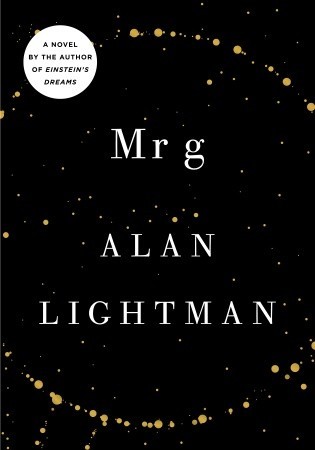
Summary: Barraged by the constant advisements and bickerings of Aunt Penelope and Uncle Deva, who live with their nephew in the shimmering Void, Mr g proceeds to create time, space, and matter. Then come stars, planets, animate matter, consciousness, and, finally, intelligent beings with moral dilemmas. Mr g is all powerful but not all knowing and does much of his invention by trial and error.
Even the best-laid plans can go awry, and Mr g discovers that with his creation of space and time come some unforeseen consequences—especially in the form of the mysterious Belhor, a clever and devious rival. An intellectual equal to Mr g, Belhor delights in provoking him: Belhor demands an explanation for the inexplicable, requests that the newly created intelligent creatures not be subject to rational laws, and maintains the necessity of evil. As Mr g watches his favorite universe grow into maturity, he begins to understand how the act of creation can change himself, the Creator.
~
Some debut novels and upcoming plans for future publications include:
Lee & Low Acquires Children’s Book Press – Publisher’s Weekly – Wendy Werris
Children’s Book Press, founded in 1975 by Harriet Rohmer for the specific purpose of creating a line of bilingual and multicultural books, ceased operations at the end of September and has sold its backlist inventory of 90 titles to Lee & Low Books in New York.
Dana Goldberg, former executive editor for Children’s Book Press, attributes the demise of the press to “a perfect storm of systemic things. We were a niche publisher for the institutional market, and 80 percent of our business came from schools and libraries. With the nationwide budget cuts, the last two years were really tough.” Goldberg also points to the challenge inherent in running a nonprofit publishing company. “We didn’t have to rely solely on book sales because of the fundraising side of the business, but in recent years our fundraising efforts didn’t meet expectations.” Children’s Book Press was distributed by Publishers Group West.
Children’s Books Get 21 Oscar Nominations – Publisher’s Weekly – Liz Hartman
Hugo, based on The Invention of Hugo Cabret by Brian Selznick, leads the pack with the most – 11– nominations, including Best Picture. War Horse, based on Michael Murpurgo’s 1982 novel, is not far behind, with six nominations (also including Best Picture). Both books were published by Scholastic. Only The Artist garnered more nominations than War Horse, with 10, while Moneyball is tied with it at six.
In addition to the Best Picture category, Hugo and War Horse will compete head to hoof for awards in Art Direction, Cinematography, Music (Original Score), Sound Editing, and Sound Mixing. Hugo also nabbed nominations for Costume Design, Visual Effects, and Writing (adapted screenplay).
The Adventures of Tin Tin and Harry Potter and the Deathly Hallows Part 2 also received nods, as many of you may already know, but none in categories most people pay attention to, such as Best Actor/Actress, Best Picture, Best Director, etc. Even still, it’s extremely exciting to see how well books-turned-movies are doing. I like to think of it as proof that books are especially valued for their stories. PW ends on a hopeful note: that since books-turned-movies are so big now, there should be an Oscar category for this as well. It’s in the Golden Globes, why not the Academy?
Divergent by Veronica Roth 
In Beatrice Prior’s dystopian Chicago, society is divided into five factions, each dedicated to the cultivation of a particular virtue—Candor (the honest), Abnegation (the selfless), Dauntless (the brave), Amity (the peaceful), and Erudite (the intelligent). On an appointed day of every year, all sixteen-year-olds must select the faction to which they will devote the rest of their lives. For Beatrice, the decision is between staying with her family and being who she really is—she can’t have both. So she makes a choice that surprises everyone, including herself.
During the highly competitive initiation that follows, Beatrice renames herself Tris and struggles to determine who her friends really are—and where, exactly, a romance with a sometimes fascinating, sometimes infuriating boy fits into the life she’s chosen. But Tris also has a secret, one she’s kept hidden from everyone because she’s been warned it can mean death. And as she discovers a growing conflict that threatens to unravel her seemingly perfect society, she also learns that her secret might help her save those she loves… or it might destroy her.
What a whirlwind! I haven’t been that tossed about since Hunger Games!
This young adult, dystopian novel depicts a war-destroyed city attempting to live in peace and harmony through various factions. However, it’s violent, it got my blood pumping, and there are tender moments that are excellently, strategically placed. Everything comes together so well, like pieces of a puzzle. Some moments in the novel are pretty stereotypical of a young adult novel: the teenagers within factions have stereotypes. The Amity, for example, are warm and friendly and wear colors of summer, while the Dauntless have more of a “goth” or “bad kid” look with black, tattoos, and piercings. The reasoning behind these factions, their purposes, and their colors are very well thought-out and each faction has strengths and weaknesses. It’s a matter of working in harmony that comes into play with this novel.
However, one of the best things about this young adult novel is that Tris is not spending her time trying to understand her feelings about boys. She focuses on herself and her loved ones. There is a love story in the midst of the violence and war, but it is not a love triangle – a fault that I personally find frustrating in young adult fiction. Roth has a purpose for each character, and through advanced technology (which, hauntingly, is highly plausible to occur anytime within the next few years) the reader can discover all sorts of dark things about each person: fears, weaknesses, the depth of intelligence. I would not call this novel “sci-fi” – it is dystopian and apocalyptic, much like Hunger Games.
This is the first book of the Divergent Trilogy. I was left with several questions that I can only assume will be answered in books 2 and 3. What is beyond the fence Dauntless guards? How many Divergents are there? Part of this next question was answered, but: why is everyone against a Divergent?
I’m thrilled for book 2, Insurgent, out in May!
Rating: ★★★★★ of 5
GoodReads: 4.4 of 5
Indie Bookstores Growing—and On the Move – Publisher’s Weekly – Judith Rosen
Just weeks after the start of the new year change is afoot at a number of indie bookstores, including going permanent (Word Up pop-up community bookstore in Washington Heights in New York City), moving (Newtonville Books in Newtonville, Mass.), and expanding (Idlewild Books in New York City).
On the other end of the spectrum, communities are working to keep independent bookstores in place! Permanence, moving, and expanding are all great things to hear. Find out if you have an independent bookstore near you that you can help out!
Wary but Determined, Publishers are Preparing for the Digital Future – Publisher’s Weekly – Calvin Reid
While publishers may be a bit daunted, they are rapidly organizing their firms for digital: 75% of publishers have an executive level person responsible for digital; 63% report that digital skills are formally integrated into all departments; 69% of the publishers expect to increase digital staffing in 2012, while 22% expect overall company staffing to go down in 2012.
For the statistically inclined.


 Scribbles & Wanderlust