Scribbles & Wanderlust
  • Home
  • About
  • Clients and Representation
  • Book Reviews
    • Reviews 2012
    • Reviews 2013
    • Reviews 2014
    • Reviews 2015
    • Reviews 2016
    • Reviews 2017
    • Reviews 2018
    • Reviews 2019
    • Reviews 2020
    • Reviews 2021
    • Reviews 2022
    • Reviews 2023
    • Reviews 2024
    • Reviews 2025
  • Features
    • Deal Announcement
    • End of Year Book Survey
    • If We Were Having Coffee
    • This Season’s Rewind
  • Discover a New Read
    • Adult
    • Young Adult
    • Middle Grade
  • Tag: genre: adult fiction

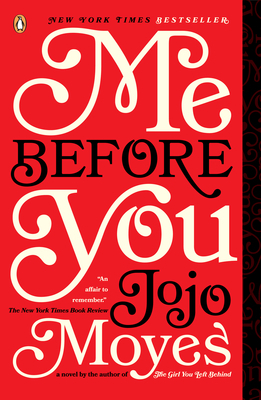
    • Book Review: “Me Before You” by Jojo Moyes

      Posted at 5:35 am by Laura, on July 21, 2016

      Me Before You by Jojo Moyes

      Publisher: Penguin Books
      Published: July 2013
      Genre: adult fiction, contemporary, women’s fiction
      ISBN: 9780143124542
      Rating: 
      ★★★★★

      Louisa Clark is an ordinary girl living an exceedingly ordinary life-steady boyfriend, close family-who has never been farther afield than their tiny village. She takes a badly needed job working for ex-Master of the Universe Will Traynor, who is wheelchair-bound after an accident. Will has always lived a huge life-big deals, extreme sports, worldwide travel-and now he’s pretty sure he cannot live the way he is.

      Will is acerbic, moody, bossy-but Lou refuses to treat him with kid gloves, and soon his happiness means more to her than she expected. When she learns that Will has shocking plans of his own, she sets out to show him that life is still worth living.

      A love story for this generation, Me Before You brings to life two people who couldn’t have less in common-a heartbreakingly romantic novel that asks, What do you do when making the person you love happy also means breaking your own heart?

      Louisa, an average girl from an average family living in an average English village, desperately needs a job to keep her family afloat. When she becomes the caretaker to Will Traynor, a wheelchair-bound quadriplegic man who used to take the world by storm, she begins to have second thoughts as to how desperately she needs employment. Will’s ever-changing moods soon become a welcoming challenge to Louisa, and their time together increases drastically. His carefully built walls fall, and she glimpses a bit of the man he used to be — and what he can still become. But Will has other plans for his life, and Louisa is torn between giving him exactly what he wants and showing him that life is still worth living.

      “Live boldly.” Those two words slayed me every time Will said them to Louisa. Here is a man hell-bent on ending his own life, advising a sheltered girl to take life by the horns and seize it at every opportunity. That, I think, is the heart of Louisa’s dilemma. Will isn’t being hypocritical. He’s reminding her that he once lived boldly, with no regrets, and would have continued to do so had he not been the victim of a terrible accident. Life in a wheelchair, after the way he’d lived, is far too debilitating to continue.

      From the very beginning you know how the book is going to end. Soon enough all the tension, the foreboding atmosphere, and racing against the clock builds up to such an emotional climax that by the time I reached the last fifty pages, I sobbed and sobbed and needed to take a break from reading to clear my eyes. It’s such an emotional release. This book sheds light on a remarkable dilemma. I’m not even sure I’d have Louisa’s strength by the end of this.

      Me Before You isn’t a full-blown romance. It’s about two individuals from very different worlds, experiencing life in very different ways, coming together and finding love in the most unlikely circumstances, and, belatedly, navigating the effects of that love and their diverging life plans. It’s not sudden and sweeping, but slow, heartbreaking, tense. The characters don’t even know what they’ve gotten into until it’s too late. I enjoy these books. It’s natural.

      While I’m aware there’s a sequel to this book, I don’t plan to read it. I enjoyed the book as is, I know where things stand, and I want to keep it that way. The characters live on powerfully enough in my mind and heart.

      rock.

      This book qualifies as book 12 of 12 of the “Rock My TBR” Challenge, hosted by Sarah @ The YA Book Traveler, in an effort to read more books off my overflowing TBR bookcase.

      Posted in books, Reviews 2016, Rock My TBR | 4 Comments | Tagged book review, books, genre: adult fiction, genre: contemporary, genre: romance, review, rock my TBR
    • Book Review: “The Lie Tree” by Francis Hardinge

      Posted at 4:15 am by Laura, on July 11, 2016

      26118377The Lie Tree by Francis Hardinge

      Publisher: Amulet
      Published: April 2016

      Genre: young adult/adult, gothic, historical fiction
      ISBN: 9781419718953
      Rating: 
      ★★★★★

      Faith Sunderly leads a double life. To most people, she is modest and well mannered—a proper young lady who knows her place. But inside, Faith is burning with questions and curiosity. She keeps sharp watch of her surroundings and, therefore, knows secrets no one suspects her of knowing—like the real reason her family fled Kent to the close-knit island of Vane. And that her father’s death was no accident.

      In pursuit of revenge and justice for the father she idolizes, Faith hunts through his possessions, where she discovers a strange tree. A tree that only bears fruit when she whispers a lie to it. The fruit, in turn, delivers a hidden truth. The tree might hold the key to her father’s murder. Or, it might lure the murderer directly to Faith herself, for lies—like fires, wild and crackling—quickly take on a life of their own.

      Faith’s family was once a respectable family in Kent, thanks to her father’s station as a reverend and natural philosopher. But when his discovery at a dig receives criticism, and jeopardizes how humans place themselves relative to other creatures on the planet, the family flees for the remote island of Vane, where gossip, unfortunately, spreads like wildfire. Soon Faith’s father is found dead, and while the island is prepared to call it a suicide, Faith is certain it’s murder. Only one of his specimens, a tree that produces fruit of truth when told dark lies, holds the secret to uncovering a twisted plot; the bigger the lie, the greater the truth.

      Holy hell. When this book received the Costa award in the UK, I knew it was something I had to pick up. It sounds unique, dark, chilling, a perfect crossover. And it is. It’s everything and more.

      I’ve been holding back on writing a review for the book because it’s so hard to describe. It’s difficult to put to words how perfect it is. The Lie Tree is more than a story about a girl avenging her father’s murder by using a fantastical tree. In fact, this book meant so much to me as a reader that my rusty, cobwebbed academic wheels began to spin. If you need a thought-provoking book for discussion, this is it.

      Beware. This “review” is essentially my 2014 graduate thesis in a nutshell. Are you ready for a novel?

      …Here we go!

      First, this is proper gothic literature. The muffled, dark atmosphere — a never-ending sense of foreboding, a constant feeling that one is being watched, hair-raising, spine-chilling — is all you need to develop the urgency in Faith’s quest, to really paint the unstable time in history and fluctuating dynamics of the household. While there’s a death, a creepy plant, and some bumps in the night, this isn’t blood and gore. This is proper horror, proper suspense, proper uncanny, and thus creates proper gothic.

      *steps down from pedestal*

      Next, we have the dualities that are so common in gothic literature. Dualities in literature make us question our beliefs, our morals, our values. They make us uncomfortable, but in a safe environment (“It’s only a book”). Faith’s father is a natural philosopher, meaning he dabbles in science and he sides with Darwin in most debates, even though he’s a reverend. He’s finding a way to combine science and religion (step one in making people at the time feel uncomfortable), but there’s another level he’s decided to tamper around. While the world is discovering dinosaurs and the expanding universe, Sunderly takes Darwin’s theory of evolution — humans come from apes — and shakes the world with his own “findings.” Ultimately, what is a human? And where are we on this ladder of life? If Earth is no longer the center of the universe, and man is no longer the center of God’s attention, who are we?

      Science versus religion, man versus angel versus animal. Okay, what else on dualities?

      How about gender roles and, within the female sphere, the two types of roles a woman could take on? There are some awful, pompous men in here that unfortunately reflect too many men today. Some of the mansplaining going on…! Poor Faith had to keep her mouth shut because a girl with an equal education and understanding to that of a man in his own field of study is shocking. (To the men, at least.) She’s supposed to boost his ego by eagerly hanging on to his every word, and attempting to comprehend his thoughts, views, and lessons. But Faith knows everything these “doctors” spout. She craves more — but she’s denied access because she’s 1) female and 2) barely of age.

      There are loads of women in this book as well. On the surface they seem to hold the two major roles Victorian women took on: Angel in the House, and Fallen Woman. There’s also the Invisible Woman, one who is left behind to take care of the family. But as you dive into the village life and get to know these various women, you find they, like Faith, lead double lives. In fact, I think two of them may be a lesbian couple…

      As I somewhat hinted, there’s another duality Faith must battle: the line between girl and woman. She’s fourteen in the novel, a gray age for Victorian females because she’s paraded in front of men but not quite formally out in society. She’s given responsibilities befitting a governess, and is sometimes trusted like a colleague instead of a daughter when she’s around her father. But something she says or does triggers the adult she’s conversing with to take a step back and mention her age. “You’re not old enough yet,” in a way. Still a child given to fancies.

      And finally, the supernatural element! Every good gothic novel needs one! I especially loved this tree. It’s the Tree of Knowledge, in some sick, twisted way. Not a bright and shining tree with golden fruit befitting Eden, but a dark, slimy one, with creeping branches and a desire for wicked lies. It shrinks when light shines upon it, and every dark secret it’s told give it the opportunity to bear fruit of truth. The only way the truth can be revealed is if it’s eaten — and the consumer falls into a drugged, opium-like state (another duality: addiction/insanity versus stable/sane). Oh, but the biology of it all; it feels so real! As if this tree could exist! Is it real? Or is it fiction? Uncanny…

      I could go on. I really could. Instead, I urge you to read this book.

      Posted in books, Reviews 2016 | 2 Comments | Tagged book review, books, genre: adult fiction, genre: fantasy, genre: gothic, genre: historical fiction, genre: mystery, genre: sci-fi, genre: young adult, review
    • Book Review: “Re Jane” by Patricia Park

      Posted at 5:15 am by Laura, on May 30, 2016

      Re Jane by Patricia Park

      Publisher: Pamela Dorman Books
      Published: May 2015
      Genre: adult fiction, contemporary
      ISBN: 9780525427407
      Rating: 
      ★★★★

      For Jane Re, half-Korean, half-American orphan, Flushing, Queens, is the place she’s been trying to escape from her whole life. Sardonic yet vulnerable, Jane toils, unappreciated, in her strict uncle’s grocery store and politely observes the traditional principle of nunchi (a combination of good manners, hierarchy, and obligation). Desperate for a new life, she’s thrilled to become the au pair for the Mazer-Farleys, two Brooklyn English professors and their adopted Chinese daughter. Inducted into the world of organic food co-ops, and nineteenth–century novels, Jane is the recipient of Beth Mazer’s feminist lectures and Ed Farley’s very male attention. But when a family death interrupts Jane and Ed’s blossoming affair, she flies off to Seoul, leaving New York far behind.

      Reconnecting with family, and struggling to learn the ways of modern-day Korea, Jane begins to wonder if Ed Farley is really the man for her. Jane returns to Queens, where she must find a balance between two cultures and accept who she really is.

      Jane Re has been told her entire life that she’s, essentially, not enough. She’s not Korean enough, American enough, intelligent enough, pretty enough. Desperate to escape her uncle oppressive household, she takes on a nannying position in Brooklyn for two English professors and their Chinese daughter. As the year rolls by, Jane begins to find a solid rooting with the family, but Ed, her boss’s husband, is beginning to cross the line. When her grandfather dies, Jane seizes the opportunity to fly to Seoul and attempt a new life there, immersing herself in modern-day Korean culture. Once again, circumstances change for her, and it’s time for her to decide how to continue her biracial, bicultural life and accept her wholly, complete self.

      I seem to be on a roll with finding great contemporary retellings of favorite classics. As I’ve said before, I’m very wary of retellings because many times they just rely too heavily on the original to be able to stand on their own. Since Jane Eyre is my favorite book, I am extra critical of all the retellings I’ve seen out there. But, like Eligible, Re Jane successfully stands on its own — and then some.

      The parallels between the two books are excellent, and the deviations from the classic are original, compelling, and authentic to this Jane’s story. I think my favorite aspect of the book was getting to experience Jane’s biracial, bicultural dilemma so intimately. The cultural awareness and sensitivity was spot on, and I hope to see more phenomenally written books like this in the market.

      I was caught in no-man’s land — the gulf between English and Korean
      felt wider than the East River and the Han combined. 

      In a non-spoilery nutshell, Jane experiences vastly different Otherness depending on her surroundings. In Flushing, Queens, she’s singled out as the “fake Korean” because her father was American. Her physical features are slightly different from the other Koreans in her neighborhood, and she’s treated as if she’s tainted or corrupt. When she works in Brooklyn, her boss Beth accidentally assumes Jane is Chinese, yet Jane and Devon (the girl she nannies) can easily see the racial differences between each other. (Devon also experiences Otherness with the other Chinese students at school, but that’s a piece of great dissection you can discover on your own!) However, when Jane jets off to Seoul, she may be teased for her archaic Korean speech, but her Otherness is praised. She carries many sought-after Western beauty features: height, nose, eyes, cheekbones. She’s been told her whole life that favoring one side of her identity is better than embracing both. Now, here she is in her mother’s homeland, being told that it’s better to be something other than fully Korean. What’s great about this is that Jane’s uncomfortable. It’s not a matter of deciding which part of her identity she should embrace over the other — it’s about understanding, loving, and combining both.

      That wasn’t so much a nutshell, but it is one aspect of the book that was deeply explored. For anyone who is following the We Need Diverse Books campaign, or #ownvoices, you need to read this book.

      This is not to say that it was condescending; instead he spoke with the weight of personal experience. More often than not, I was able to free-ride on the shorthand of his authority. […] But at times I wondered whether I relied too heavily on Ed’s account of things, rather than seeing for myself.

      It’s not possible to talk about any Jane Eyre retelling without some mention of the Mr Rochester figure. Ed was cool, I liked Ed, I could see Jane with Ed, and not once did I ever feel uncomfortable with the thought that Ed was roughly 10-15 years older/her employer/married. Many times retellings fall flat with the romance aspect because there’s too much emphasis on the age gap. In the 1840s, the age difference was not an issue. It’s the fact he was her employer, in the beginning at least. So why do so many retellings focus on the age?

      Well, thank goodness Park did not do that. She instead focused on certain aspects of age differences in relationships. Someone who is 10+ years older, who married, had a child, bought a first home, bought a first car, will definitely have more life experiences, and that’s bound to create communication issues. The drama in the relationship between Jane and Ed focused on that: how they spoke to one another, and how they interacted with other couples in their respective age groups. If you’ve read Re Jane, I love to hear your thoughts on this!

      This qualifies as book 6 of 10 library books in 2016. 

      Posted in books, Reviews 2016 | 7 Comments | Tagged book review, books, genre: adult fiction, genre: contemporary, review
    • Mini Reviews VI

      Posted at 5:30 am by Laura, on May 23, 2016

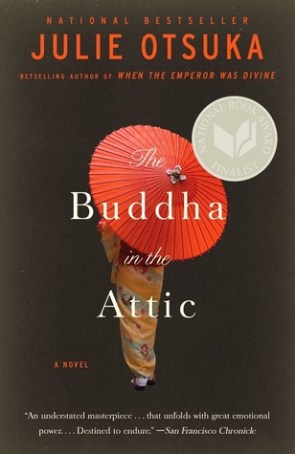
      13052956The Buddha in the Attic by Julie Otsuka

      Publisher: Anchor
      Published: March 2012
      Genre: adult, historical fiction
      Summary: 
      A gorgeous novel that tells the story of a group of young women brought from Japan to San Francisco as “picture brides” nearly a century ago. The story traces the extraordinary lives of these women, from their arduous journeys by boat, to their arrival in San Francisco and their tremulous first nights as new wives; from their experiences raising children who would later reject their culture and language, to the arrival of war. This is a spellbinding novel about identity and loyalty, and what it means to be an American in uncertain times.

      Review: I’ve never come across a narration quite like this before. It was written in plural — “we” and “us” instead of “I” or “she.” (Grammar nerds, please tell me the correct name for it!) This narrative style is fitting, as this short book details the lives of Japanese “picture brides” coming to San Fransisco in 1917, working the lands, raising children, and disappearing during WWII. As a society that values the group over the individual — and told through the eyes of women — it makes sense for the structure to follow that narrative style, too. These poor women, these lost voices, were so hopeful in the beginning for a new and prosperous life, only to find their husbands were lies; they would continue to work the land; they might eventually work in laundries or great homes; they would raise their children as Japanese only to find their children shamed and rejecting their culture for an American one; they would wake up in the morning to an empty bed and no husband in sight; and they would, one by one, leave their homes and cross the Rockies, never to be seen or heard from again. Thought-provoking.

      This qualifies as book 4 of 10 library books in 2016. 

      535412Wide Sargasso Sea by Jean Rhys

      Publisher: W.W. Norton Company
      Published: November 1998 (first published in 1966)
      Genre: adult, historical fiction
      Summary: 
      The novel is Rhys’s answer to Jane Eyre. Charlotte Brontë’s book had long haunted her, mostly for the story it did not tell–that of the madwoman in the attic, Rochester’s terrible secret. Antoinette is Rhys’s imagining of that locked-up woman, who in the end burns up the house and herself. Wide Sargasso Seafollows her voyage into the dark, both from her point of view and Rochester’s. It is a voyage charged with soul-destroying lust. “I watched her die many times,” observes the new husband. “In my way, not in hers. In sunlight, in shadow, by moonlight, by candlelight. In the long afternoons when the house was empty.”

      Review: The one reason I’m not giving this one star is because it’s an excellent example of colonialism and racism in the nineteenth century. The book’s saving grace is the academic fodder for discussion. Apart from that, I had a hard time caring about Bertha, or understanding the motivations and personalities of the characters. It’s not a compelling story, and I’m not sure it could stand on its own. It’s as if the only way this could be read is alongside or after reading Jane Eyre. Otherwise the writing feels disjointed, disconnected, and lost.

      This qualifies as book 5 of 10 library books in 2016. 

      Posted in books, Reviews 2016 | 6 Comments | Tagged books, genre: adult fiction, genre: historical fiction, mini review, review
    • Book Review: “Eligible” by Curtis Sittenfeld

      Posted at 4:15 am by Laura, on May 18, 2016

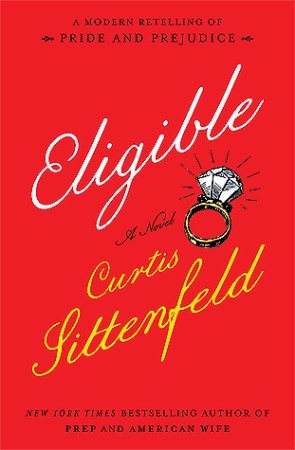
      25852870Eligible by Curtis Sittenfeld

      Publisher: Random House
      Published: April 2016
      Genre: adult fiction, contemporary
      ISBN: 9781400068326
      Rating: 
      ★★★★

      This version of the Bennet family—and Mr. Darcy—is one that you have and haven’t met before: Liz is a magazine writer in her late thirties who, like her yoga instructor older sister, Jane, lives in New York City. When their father has a health scare, they return to their childhood home in Cincinnati to help—and discover that the sprawling Tudor they grew up in is crumbling and the family is in disarray.

      Youngest sisters Kitty and Lydia are too busy with their CrossFit workouts and Paleo diets to get jobs. Mary, the middle sister, is earning her third online master’s degree and barely leaves her room, except for those mysterious Tuesday-night outings she won’t discuss. And Mrs. Bennet has one thing on her mind: how to marry off her daughters, especially as Jane’s fortieth birthday fast approaches.

      Enter Chip Bingley, a handsome new-in-town doctor who recently appeared on the juggernaut reality TV dating show Eligible. At a Fourth of July barbecue, Chip takes an immediate interest in Jane, but Chip’s friend neurosurgeon Fitzwilliam Darcy reveals himself to Liz to be much less charming. . . .

      And yet, first impressions can be deceiving.

      Liz travels back with her sister Jane to Cincinnati after their dad, Mr. Bennet, suffers a heart attack. They say they’ll only stay as long as he needs them, but the sisters find the house is falling apart — and their younger sisters are in dire need of some life coaching. When cousin Willie comes to town and the Lucas family hosts a barbeque, Liz and Jane run into doctors Fitzwilliam Darcy and Chip Bingley. Little do they know, this dinner party changes the course of their lives.

      Of all the Jane Austen Project books so far, this one is the best. All the key characters and scenes are there — the bare bones of Pride & Prejudice — and Sittenfeld seamlessly uses those elements in a modern setting, rather than trying to squeeze modern life inside an Austen novel. The classic humor is there, the personalities of the characters, everything. Of course Mary would be the snarky, multi-degreed student holed away in her parents’ house. Of course Jane would be a calm yoga instructor. Of course Bingley would be on a reality show, and Mrs. Bennet a shopaholic, and Willie a Silicon Valley nerd. Social media plays a huge role in the novel as well, and it works.  This book was written so cleverly to properly match modern time, it didn’t feel like a forced retelling of Pride & Prejudice.

      While Eligible is a retelling of an Austen classic, it’s also a character study. Liz is a fantastic journalist, critiques her family and deeply loves them at the same time, and is (hilariously) clueless with men. She’s intelligent and confident, but her weaknesses are relatable as well. There are some parallels with the classic Elizabeth Bennet, but Liz can stand on her own.

      I’m sure you’ve read the reviews and seen the hype by now. Trust in it. Eligible is worth a read.

      Posted in books, Reviews 2016 | 9 Comments | Tagged book review, books, genre: adult fiction, genre: contemporary, review
    • Book Review: “Fever at Dawn” by Peter Gardos

      Posted at 5:45 am by Laura, on May 7, 2016

      25897908Fever at Dawn by Péter Gárdos

      Publisher: Houghton Mifflin Harcourt
      Published: April 2016
      Genre: adult fiction, historical fiction
      ISBN: 
      9780544769793
      Rating: ★★★★

      July 1945. Miklos is a twenty-five-year-old Hungarian who has survived the camps and has been brought to Sweden to convalesce. His doctor has just given him a death sentence — his lungs are filled with fluid and in six months he will be gone. But Miklos has other plans. He didn’t survive the war only to drown from within, and so he wages war on his own fate. He acquires the names of the 117 Hungarian women also recovering in Sweden, and he writes a letter to each of them in his beautiful cursive hand. One of these women, he is sure, will become his wife.   In another part of the country, Lili reads his letter and decides to write back. For the next few months, the two engage in a funny, absurd, hopeful epistolary dance. Eventually, they find a way to meet.

      Determined to survive long after the brutal war in concentration camps, Miklos devises a plan to make the most of his life and fight against the fluid building up in his lungs. He writes beautiful letters to 117 Hungarian women who are also recovering in hospitals in Sweden, with hopes that at least one of them may become his wife. Lili, recovering in a hospital across the country, reads his letter and writes back on a whim. Over the next six months, as Lili regains her strength and Miklos battles a ticking clock, the pair fall in love. But falling in love through words is a dangerous game, for how will they ever meet in person? Standing up against hospital policies and fighting against their own health, Miklos and Lili will do whatever it takes to be together and start life anew.

      Translated fiction is usually hit or miss with me. The language can feel stilted or ridiculous, and as a result it keeps me at a distance from the narrative. But this one is definitely a hit. Though there were moments when it was painfully obviously this was a translated work, I cannot stress enough how easy it was to gloss over that little bump and continue falling head over heels into the story. And that’s what we’re all after, right? Right.

      Miklos is a such a twenty-five-year-old guy. The doctor tells him he’s going to die in six months, and what does Miklos do? Plan a future with a woman, any woman, who writes back to his letters. But unlike other twenty-something guys, the war has made him humble. His mind is full of spirit but his body is on the mend, he loves to smile but his metal teeth frighten people, he has such passion for intellect and beauty that it can sometimes be intense. His mind draws Lili in, and her heart, spirit, and mind draw him to her. He wasn’t going to fall for any woman who wrote back – he was going to fall for her. No question.

      There are so many moments that resonate with contemporary love stories that it’s no wonder this has been published and translated into so many languages. Trade letters for tweets or online dating messages, trade hospitals for countries, trade phone calls to skype chats, and you have this story again. But what makes this such a gem is the determination for starting over and creating a better life, a new life, after all the death and destruction these two witnessed, lived, and survived so young. Toss in the fact this is based on the author’s own parents’ stories and letters, and you’re in for a teary ride.

      If you’re looking for a story that unfolds slowly, told with humor and heart, you’ll find that with Fever at Dawn.

      Thank you, NetGalley, for providing the advance copy from HMH for review!


      Posted in books, Reviews 2016 | 4 Comments | Tagged advance reading copy, book review, books, genre: adult fiction, genre: historical fiction, review
    • Book Review: “Assassin’s Apprentice” by Robin Hobb

      Posted at 4:45 am by Laura, on April 27, 2016

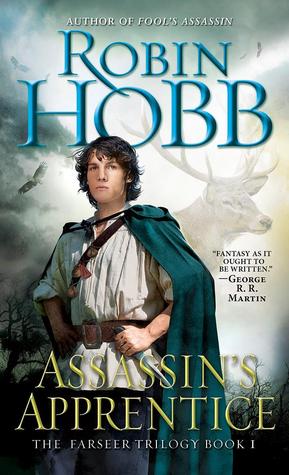
      23200621Assassin’s Apprentice by Robin Hobb

      Publisher: Del Rey
      Published: April 1995
      Genre: adult, fantasy
      ISBN: 9780553573398
      Rating: 
      ★★★

      Young Fitz is the bastard son of the noble Prince Chivalry, raised in the shadow of the royal court by his father’s gruff stableman. He is treated as an outcast by all the royalty except the devious King Shrewd, who has him secretly tutored in the arts of the assassin. For in Fitz’s blood runs the magic Skill–and the darker knowledge of a child raised with the stable hounds and rejected by his family.

      As barbarous raiders ravage the coasts, Fitz is growing to manhood. Soon he will face his first dangerous, soul-shattering mission. And though some regard him as a threat to the throne, he may just be the key to the survival of the kingdom.

      Fitz can’t remember too much of his early life, apart from working as a stable boy and bonding really well with the animals. When King Shrewd acknowledges Fitz is the bastard son of Prince Chivalry, he has a plan sorted just for Fitz, one that marks him above a commoner but not quite nobility. Fitz will be a trained assassin, using his Skill to assist his mission. But as raiders attack the kingdom’s coast, Fitz’s assignment becomes all too real, and a complicated web of deceit may be his undoing.

      This book seems to have followed me around for the last few months without any intention on my part! It was a gift from my Secret Santa, Samantha, it was one that a friend eyed and purchased over the holidays, and it was chosen as the Flights of Fantasy Book Club pick for March. MARCH. It is now April and I’ve finally finished it. A belated review for this book club pick. And hopefully I can shed some light as to why.

      Hobb’s writing style is one that begs to be absorbed across long sittings. Once you’re involved with Fitz’s narrative, the prose becomes engrossing and the story picks up its pace. But if you’re a chapter-before-bed kind of reader, you may be out of luck with this one. Reading small portions each day made the book feel slow and plodding.

      This first book in the Farseer trilogy is also full of character development and insight. We watch Fitz grow from about six years old to early young adulthood, and experience a whole spectrum of events with him. He’s an outcast because he’s a bastard child, but he’s neither commoner, servant, nor noble. He’s of royal blood but cannot be given special privileges, yet there’s no denying he has the Skill, which runs through royal families. He’s in quite the predicament, and the King, as well as his subjects, treat Fitz as such.

      Overall, I did enjoy the book, but it took me two months to get through it. If I had time to sit across a weekend and be completely immersed in it, I’m sure I would’ve loved it. I am curious to see what happens to Fitz, and the writing really is beautiful — so I plan to read the second book too.

      fof-button-2016.

      This qualifies as book 5 of 5 of the “Flights of Fantasy” Challenge, hosted by Alexa @ Alexa Loves Books and Rachel @ Hello, Chelly.

      .

      rock.

      This book qualifies as book 7 of 12 of the “Rock My TBR” Challenge, hosted by Sarah @ The YA Book Traveler, in an effort to read more books off my overflowing TBR bookcase.

      Posted in books, Flights of Fantasy, Reviews 2016, Rock My TBR | 2 Comments | Tagged book review, books, flights of fantasy, genre: adult fiction, genre: fantasy, review, rock my TBR
    • That One Time I Binged on Kinsella… II

      Posted at 5:55 am by Laura, on April 25, 2016

      kinsella

      Welcome back to the second edition of That One Time I Binged on Kinsella! Last time we discussed I’ve Got Your Number and The Undomestic Goddess, as well as what inspired my Kinsella binge in the first place: Can You Keep a Secret? Now we’re here to discuss two more non-Shopaholic Kinsella books.

      7100264
      3178754

      Twenties Girl (★★★.5) surprised me in many ways. At first I didn’t think I would enjoy it as much as everyone said — a ghost great-aunt? really? — but I absolutely sank into it! Lara’s romantic storyline hit a little too close to home for me, so I found it difficult in the beginning. Sadie, Lara’s great-aunt/ghost, could be annoying and conceited, but that changed as the story developed more and we could explore her character. There’s a surprising thread in the story that deals with art and art history, which was fun and really amped up the pace. When Lara’s Trump-like uncle gets involved with the art deal — and the overall family history — Lara comes to terms with many aspects of her life and takes control.

      And it’s that “taking control of your life” thread that made Twenties Girl enjoyable. The Lara at the beginning of the book is clinging to a rather poor and directionless job, lacks strong familial relationships, feels isolated from friends, and is quite obsessive with a dead relationship. Sadie tries to snap her out of it, simultaneously teaching her (in her nagging, Sadie way) to live each day fully and to know when to fully invest in something worthwhile. By the end of the novel, Lara has sorted her priorities and knows what she wants in life.

      Remember Me? (★★★) has an intriguing premise: what if you lost your memory from the last three years, and found your life is completely different? New appearance, new job, new set of friends, a marriage? Now if that happened to me, I’d have a full-blown panic attack. But in typical Kinsella fashion, Lexi uses these positive changes (she’s gorgeous! She’s the boss! She has a hot, rich husband!) to her advantage and attempts to put the pieces of the puzzle together in a humorous way. How did she go from poor and struggling to a success? There are two accidents in the novel, and I had such a great theory going from about page 50 that was completely debunked in the last three chapters. Prepare for the twist!

      Though it’s mostly discussed through Lexi’s romantic entanglements — her husband versus Jon, the successful but laid-back architect her husband employs — Kinsella touches upon glossy exteriors and their hidden flaws. On the surface, it looks like Lexi woke up to the perfect life. But those perfections do not make up Lexi, a quirky, fun, kind, flawed individual. She has a beautiful, state-of-the-art, magazine-spread home, but there’s nothing in there that feels personal, homey, or lived in. She’s the head of a department in a big company, but her employees see her as a cutthroat snake, something Lexi most certainly is not. She’s married to a gorgeous businessman, who fits everything on a dream checklist, but that checklist does not equal a dream relationship. It seems perfect and wonderful and safe, but flaws make life enjoyable. And in the case of Lexi’s relationship with Jon, they are far more equal to each other, and that’s a healthy lifestyle.

      ~

      I read Kinsella at just the right time in my life. As I alluded to a few weeks ago, the beginning of 2016…well, sucked. Kinsella brought smiles and humor. And in each of the novels I read, I found a little something to relate to that also lifted me up. Can You Keep a Secret? spoke to me on a billion levels, most especially in the career fumbles and trying to prove oneself. I’ve Got Your Number shared the same fluctuating confidence and self-doubt I experience daily, and The Undomestic Goddess reminded me that it’s possible to try new things and still remain exactly who you are. Twenties Girl taught me to be bold, and Remember Me? encouraged me to look beyond the glossy exterior and into the heart of things.

      I’m sure plenty of readers felt the same way about her novels, for any of the protagonists in any of their situations. Kinsella’s books are semi-predictable, they’re quick reads, and you can guarantee some laughter. But I think that’s what makes them so enjoyable: her voice is accessible and relatable to so many women. You can’t help but love the characters and wince over their hilariously embarrassing situations. You’re glad this isn’t your life, and at the same time, this is your life. And it brings such comfort.

      Have you read Kinsella? What are some of your favorite books?

      Posted in books, Reviews 2016 | 6 Comments | Tagged books, genre: adult fiction, genre: contemporary, genre: romance, mini review, review
    • Classic & Re-Read: “Emma” by Jane Austen

      Posted at 4:30 am by Laura, on April 15, 2016

      Two birds with one stone in this post! Each challenge has slightly different questions, so this’ll make for an interesting review and discussion of Jane Austen’s Emma.

      2016classicschallenge1

      Stacey @ The Pretty Books is hosting the Classics Challenge in an effort to read more classic literature — and you can define “classic” however you wish! Sign up and start reading literature that’s standing the test of time. 

      Book #1 of 2016:
      Emma by Jane Austen (1815)

      9780143106463_Emma_ClaDlx.indd
      7181805
      6969

      WHEN I Discovered This Classic

      The first time I read Austen must’ve been in middle school, around 12 years old. I bought two volumes that had her six novels, and I’m pretty sure I breezed through all of them. Only four stick out to me and I read often — Emma would not be one of them! It was firmly one of my least-favorite at the time, so I just stuck to the BBC adaptation and called it a day.

      WHY I Chose to Read It

      It’s been over 14 years, more or less, since I read it, and I love the BBC adaptation. So maybe my adolescent opinion isn’t worth listening to and I ought to re-read this classic again! (Plus, come on, Austen said she loved Emma-the-character. Gotta give her a chance!)

      WHAT Makes It A Classic

      Because it’s Austen. But I’m not sure what exactly made Austen a classic. Possibly because her stories are universal, satirical, well-written, interesting. Austen understood people.

      WHAT I Thought of This Classic

      I definitely have a higher opinion of Emma! Though it’s still not one of my favorite Austens, it was nice to be back in her style of writing. Mr Knightley is sassy and realistic, I do not like Frank Churchill (what an awful flirt), Mr Woodhouse is far more of a hypochondriac than I remembered or expected, and Emma, though difficult, was fun to watch. Check out my full thoughts in my re-read section!

      WILL It Stay A Classic

      Of course! It’s Austen, it’s a classic. It inspired one of the greatest 90s movie classics, too: Clueless. That match-making-gone-wrong story is a classic trope as well. Not sure if it started because of Austen, but it’s something that audiences gravitate to.

      WHO I’d Recommend It To

      Anyone who enjoyed the BBC adaptation, Clueless, or matchmaking stories. Emma is so much more than that, but it’s definitely the draw to the novel.

      ReRead2016Graphic

      Kelly @ Belle of the Literati is hosting a fun challenge for bloggers: The Re-Read Challenge! Not much of a “challenge,” per se, because why wouldn’t you want to re-read and re-experience some of your favorites? Sign up and start re-reading!

      Book #2 of 2016:
      Emma by Jane Austen

      2726761
      15777407
      894048

      WHEN I First Read

      As stated before (the one overlap question, yay!), I was probably 12 when I first read Emma.

      WHAT I Remember

      Nothing particularly detailed in this book except that I found Emma to be snobbish when I first read it. I also remembered Mr Knightley scolding her a lot. (And yet, of course, the BBC adaptation became most of what I remembered. How do you know when a show/movie blurs the original work too much?)

      HOW I Felt After Re-Reading

      Relieved the BBC stayed true to the work, and pleasantly surprised. I took some notes while I was reading (because who doesn’t do that with a classic?), and here’s what stood out:

      HARRIET / MR MARTIN / MR ELTON — Emma’s snobbery clouds Harriet’s judgement of the sweet and perfect Mr Martin in chapter four. How incredibly fast! Harriet was such an impressionable character, but she came to her own by the end. I was also surprised with how large a role Mr Martin had in the books, too, as a tertiary character. His random appearances spark Harriet out of each of her “I love Mr ___” stupors.

      EMMA / MR ELTON / FRANK CHURCHILL — What Churchill did to Emma is exactly what Emma did to Mr Elton, in a way. Both characters unknowingly led another on; such flirts! Yet I have a hard time forgiving Churchill the way I could forgive Emma. Emma, at least, didn’t seem like she realized she was flirting with Mr Elton and leading him on. In adaptations it’s quite obvious Elton is infatuated with Emma, but in the book it wasn’t. Despite Churchill’s explanatory letter and apology (side note: I love that Austen has letters from men in her novels so they can explain themselves!), I have a hard time understanding how Jane Fairfax could still marry him after all those months.

      EMMA / MR KNIGHTLEY — The confessions to one another before the proposal are awesome. They’re not apologizing for their behavior, but they can explain their conduct and recognize or admit to their faults. It’s huge for Emma to do so. She’s always arguing with Knightley, but he tends to make a fair point. After all of that, she’s still the same kind of Emma — argumentative, observant, nosy — but with growth and wisdom. They don’t completely change at the turn of a page, like many characters in books do. They grew up.

      EMMA — You can’t really blame Emma for her pompous attitude and rudeness, though. She has the most hypochondriac of fathers, no travel experience, and the only challenging conversations she has are with Knightley, who, despite his scolding, treats her more like an equal than anything else.

      WOULD I Re-Read Again

      I’m not sure I would read this Austen again any time soon, but I would definitely reread it again in my lifetime!

      What books have you reread recently? What classic have you read recently?

      Posted in books, Classics Challenge, ReRead2016, Reviews 2016 | 8 Comments | Tagged books, classics challenge, genre: adult fiction, genre: classics, reread2016
    • That One Time I Binged on Kinsella…

      Posted at 4:15 am by Laura, on March 11, 2016

      kinsella

      Over the last couple of weeks, I’ve been itching for romcoms — not movies, but books. Something light and fun that also doesn’t make me want to gouge my eyes out over the lack of character depth or completely ludicrous and implausible situations. Even in my darkest days I still want to read something with quality! But what would I read? I wanted to read adult fiction, but I tend to gravitate to fantasy, historical, and a bit darker (aka “sadder”) contemporary on my adult fiction TBR bookcase. I looked at my Read shelves and thought “Hmmm…is there something similar to The Royal We that I could binge-read?” And Sophie Kinsella immediately popped into my head!

      Because I enjoyed Finding Audrey so much, and I like all the concepts behind Kinsella’s non-Shopaholic books, I decided to dive in and try reading her adult fiction. She grabbed my attention with Emma Corrigan in Can You Keep a Secret? and now I can’t get enough! Though her books follow something of a formula (young twenty-something career woman experiences painfully, hysterically embarrassing situations and comes to her own, all with a light little romance on the side), it’s the narrator’s anxious, driven, silly brain that feels so akin to my own that draws me in! I am that young twenty-something career-focused woman stumbling through Adulthood and trying to Prove Herself. Give me your silly, scattered heroines, Kinsella. I’m ready.

      15823429
      33722

      I’ve Got Your Number (★★★.5) was an excellent second choice after reading and loving Can You Keep a Secret? Poppy’s character and inner monologue speaks to me on such a deep level. Reading her fluctuating confidence/responsibility and self-doubt/insecurity makes me want to shove this book into people’s hands to better understand me, in a way. This was also an incredibly millennial book too. The digital elements to this — our society’s need to be in touch with everything and everyone and all times — was all too relatable. I’d die* without my phone, as I need it for work and personal life and social media and games and notes and reminders, and it’s not like I even use all those smart phone apps in the first place. Just your basic smart phone stuff! But wouldn’t it be nice to not have it for a while? How peaceful does that sound? Anyway, Poppy’s digital part of story was funny and surprisingly crucial to the plot.

      As for the romantic elements in this book, I have a note in my scribbled-on-scrap-paper review: “obvs disliked Magnus because wtf who is this guy.” I don’t think anything more needs to be said on that. I wanted more from Sam’s character, as it felt like all we really saw was the business side of him, but he certainly wasn’t dislikable. The ending was very much a cheesy romcom movie ending, a bit unbelievable, but certainly cute for this kind of novel, and I’m okay with that!

      *exaggeration, I promise

      The Undomestic Goddess (★★★) had a bit of a slow start for me, but quickly turned into laugh-out-loud entertainment during all of Samantha’s kitchen and laundry mishaps. I especially related to her with her cooking inexperience. As someone who can set a boiling pot of water on fire** I understood her anxiety during her first cooking lesson with the gardener’s mother. The juxtaposition of Sam’s character in the law firm in London — stressed, frazzled, tired, overworked, unaware of her unhealthy eating habits — and the domestic job in the Cotswolds — easy-going once she learned how to operate the oven and washer, peaceful, open — was brilliantly done. Though the locations and her situation changed, she stayed true to herself.

      And again, as for the romantic elements? Swoon. Nathaniel was great, and I couldn’t help but picture Matthias Schoenaerts as Gabriel Oak in Far from the Madding Crowd from the moment he entered the kitchen and witnessed Sam’s string of mishaps. While Sam’s employers were absolutely ridiculous (if they were real people, I would’ve snapped at some point) and the premise was quite cheesy, it was all around enjoyable good fun.

      **I don’t even know

      Remember Me? and Twenties Girl are next on my list, and I’m super excited to dive into them. Stay tuned for another Kinsella post!

      xxx

      Posted in books, Reviews 2016 | 10 Comments | Tagged books, genre: adult fiction, genre: contemporary, genre: romance, mini review, review
    ← Older posts
    Newer posts →
    • Hello, I’m Laura!

      I'm a bookish bookworm and book hoarder. By day I'm a literary agent, and by night I'm forever rearranging my bookshelves. I could talk your ear off about Gothic literature, and in my past life people thought I'd become a professional musician. I have a fluffy black cat named Rossetti, I love to travel, tea is my drink of choice, British TV is the best, and I'm always down for chips-and-queso nights. Welcome to Scribbles & Wanderlust! Grab your favorite hot beverage and let's chat books!
    • Search the Blog

    • Currently Reading

    • Book Review Rating Key

      ★★★ — It’s good
      ★★★★ — It’s great
      ★★★★★ — OMG LOVE!!!

    • Recent Posts

      • MSWL for 2026
      • Favorite Reads of 2025
      • Deal Announcement: Nina Moreno, YA Romance
      • Deal Announcement: Sharon Choe, YA Fantasy
      • Deal Announcement: Hanna R. Neier, MG Historical/Contemporary

Blog at WordPress.com.

Scribbles & Wanderlust
Blog at WordPress.com.
  • Subscribe Subscribed
    • Scribbles & Wanderlust
    • Join 1,204 other subscribers
    • Already have a WordPress.com account? Log in now.
    • Scribbles & Wanderlust
    • Subscribe Subscribed
    • Sign up
    • Log in
    • Report this content
    • View site in Reader
    • Manage subscriptions
    • Collapse this bar
 

Loading Comments...