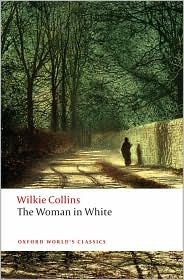
The Woman in White by Wilkie Collins 
The story begins with an eerie midnight encounter between artist Walter Hartright and a ghostly woman dressed all in white who seems desperate to share a dark secret. The next day Hartright, engaged as a drawing master to the beautiful Laura Fairlie and her half sister, tells his pupils about the strange events of the previous evening. Determined to learn all they can about the mysterious woman in white, the three soon find themselves drawn into a chilling vortex of crime, poison, kidnapping, and international intrigue.
English Victorian literature: my favorite genre! I would have read this even if it was not assigned for my Gothic Literature course.
Collins was a friend and pupil of Charles Dickens, and it shows in his writing style. At a time when authors were paid by the word and published serially in journals, long episodic novels such as this was the fashion. With each journal publication, a few sections of Woman in White would be published and read, much like TV episodes air weekly. The characters closely analyze situations from different angles, almost to the point of repetition – which serves as a reminder of this novel’s literary and historical context: the readers needed those reminders once in a while.
Collins also employed a technique that was new in literature for the time, and rather common today: a story told from different narratives. For several chapters, the mystery was given by Walter Hartright, then his pupil Marian, followed by the villain, lawyers, and other characters whose roles become vital to the plot. For this particular story, which the law cannot legally touch, multiple narrators was necessary and skillfully done.
This book was chilling, fascinating, and slow-paced. It cannot be read quickly. Very critical moments occurred without my noticing until after the fact. Gender roles blurred, the line between fantasy and reality was crossed, and intrigue kept the plot moving.
One of literature’s most gender-bending characters, Marian Halcombe, starred alongside one of literature’s most lovingly hateful villains, Count Fosco. I thoroughly enjoyed their accounts in the narrative. Marian, with her mustache and desire for male independence, stealing out into the night and climbing across mansion roofs; Fosco, enormously obese yet light on his feet, cruel and charming all at once – their character depth drove the story forward. They constantly tip-toed around one another, analyzing the other’s every move like a chess game.
And of course, there’s the mystery of the woman in white…which will only be revealed when read!
Rating:  of 5
of 5
Goodreads: 3.97 of 5




 Scribbles & Wanderlust