Scribbles & Wanderlust
  • Home
  • About
  • Clients and Representation
  • Book Reviews
    • Reviews 2012
    • Reviews 2013
    • Reviews 2014
    • Reviews 2015
    • Reviews 2016
    • Reviews 2017
    • Reviews 2018
    • Reviews 2019
    • Reviews 2020
    • Reviews 2021
    • Reviews 2022
    • Reviews 2023
    • Reviews 2024
    • Reviews 2025
  • Features
    • Deal Announcement
    • End of Year Book Survey
    • If We Were Having Coffee
    • This Season’s Rewind
  • Discover a New Read
    • Adult
    • Young Adult
    • Middle Grade
  • Category: Reviews 2012

    • Book Recommendation: “Lost In Austen”

      Posted at 5:01 pm by Laura, on July 2, 2012

      Not a review, but a recommendation for Austen enthusiasts: Lost in Austen: Create Your Own Jane Austen Adventure by Emma Campbell Webster.

      The journey begins in Pride and Prejudice but quickly takes off on a whimsical Austen adventure of the reader’s own creation. A series of choices leads the reader into the plots and romances of Austen’s other works. Choosing to walk home from Netherfield Hall means falling into Sense and Sensibility and the infatuating spell of Mr. Willoughby. Accepting an invitation to Bath leads to Northanger Abbey and the beguiling Henry Tilney. And just where will Emma‘s Mr. Knightley fit in to the quest for a worthy husband? It’s all up to the reader.

      The point of the adventure is to marry well and happily. Took a while, as I died several times: falling on ice, smothered by pillows, committing a crime, and getting run over by a carriage…But eventually I married and prevailed!

      Remember to play YOU. Not Lizzie Bennet. You will have more fun and adventures by taking the paths you would follow.

      Posted in books, Reviews 2012 | 0 Comments | Tagged books, review
    • Book Review: “Romancing Miss Brontë” by Juliet Gael

      Posted at 11:02 pm by Laura, on June 29, 2012

      Romancing Miss Brontë by Juliet Gael

      During the two years that she studied in Brussels, Charlotte had a taste of life’s splendors—travel, literature, and art. Now, back home in the Yorkshire moors, duty-bound to a blind father and an alcoholic brother, an ambitious Charlotte refuses to sink into hopelessness. With her sisters, Emily and Anne, Charlotte conceives a plan to earn money and pursue a dream: The Brontës will publish. In childhood the Brontë children created fantastical imaginary worlds; now the sisters craft novels quite unlike anything written before. Transforming her loneliness and personal sorrow into a triumph of literary art, Charlotte pens her 1847 masterpiece, Jane Eyre.

      Charlotte’s novel becomes an overwhelming literary success, catapulting the shy and awkward young woman into the spotlight of London’s fashionable literary scene—and into the arms of her new publisher, George Smith, an irresistibly handsome young man whose interest in his fiercely intelligent and spirited new author seems to go beyond professional duty. But just as life begins to hold new promise, unspeakable tragedy descends on the Brontë household, throwing London and George into the background and leaving Charlotte to fear that the only romance she will ever find is at the tip of her pen.

      But another man waits in the Brontës’ Haworth parsonage—the quiet but determined curate Arthur Nicholls. After secretly pining for Charlotte since he first came to work for her father, Arthur suddenly reveals his heart to her.

      Usually when an author takes liberties to devise a fictional account of another’s life, it’s poorly written, cheesy, and extremely wild and romantic in its imaginings. Sometimes the truth is twisted to fit the author’s wish for a better outcome. This happens constantly with Jane Austen, but so far I’ve read two books (including this one) that portray Charlotte Brontë as true to life as possible based on literary and academic scholarship (the other: Jude Morgan’s Charlotte and Emily), no frills added, and so strikingly similar to one another and all the research that, to a fan and Brontë scholar, must speak the truth.

      And for that, I have to say this is one of my favorite books.

      Charlotte led such a hard life and I find her and the family utterly fascinating. They each desired love and affection, passions that would throw them off their feet, and yet also desired to be reclusive and alone. This duality speaks to me as an individual – and for someone who may not feel the same, Gael did an excellent job describing Charlotte’s dilemmas. Not a moment of the book was rushed, which is such a blessing. This spans across a decade of Charlotte’s life, and everyone who shaped her eventually shaped her novels. The influence is key to every moment of her life, and any subject – such as her crush on her publisher, the way she snubbed the curate and later fell in love, the way she portrayed herself to various friends in her letters – was given its proper justice and detail.

      Academic and literary truth aside, it was still vastly entertaining! We learn more about Emily, Anne, and Branwell; the insecurities Charlotte felt about her appearance; the overbearing clergyman father; the duties of the curate Arthur; the stardom the “Bell brothers” faced and who they met – far more interesting than reading a biographical description! The language is beautiful as well, and truly mimics the way Charlotte wrote in her letters. Each character had a distinct personality without exaggeration, and despite knowing how everyone’s story ended, I was anxious to see how it would be written. An author that tackles a topic wherein the reader already knows the ending is certainly an author to admire – the fact Gael kept me on the edge of my seat deserves an award!

      Finally, I’m so glad Gael gave life and breath to Arthur. She had little information to work from, but what information she had were derived from first-hand accounts recorded by Charlotte and Arthur’s friends and neighbors. The language of the time would suggest criticism or flattery, and I think Gael did a wonderful job of shaping just the right kind of man he must have been. He was no random, ordinary man who waltzed into the home and asked for her hand in marriage; no, he was there throughout all  of her joys and sorrows, on the edge, waiting for the perfect moment, and gave her the happiest last few months of her life.

      Fantastic book. Utterly beautiful.

      Rating: ★★★★★ of 5
      Goodreads: 3.81

      Posted in books, Reviews 2012 | 0 Comments | Tagged authors, book review, books, genre: adult fiction, genre: classics, genre: fiction, genre: history, history, review
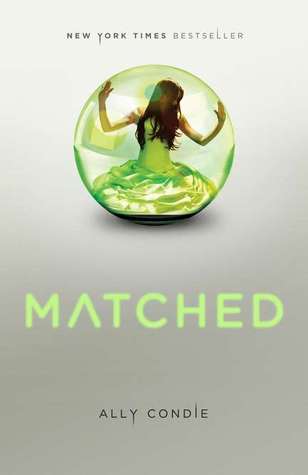
    • Book Review: “Matched” by Ally Condie

      Posted at 9:41 am by Laura, on June 19, 2012

      Matched by Ally Condie

      Cassia has always trusted the Society to make the right choices for her: what to read, what to watch, what to believe. So when Xander’s face appears on-screen at her Matching ceremony, Cassia knows with complete certainty that he is her ideal mate… until she sees Ky Markham’s face flash for an instant before the screen fades to black.

      The Society tells her it’s a glitch, a rare malfunction, and that she should focus on the happy life she’s destined to lead with Xander. But Cassia can’t stop thinking about Ky, and as they slowly fall in love, Cassia begins to doubt the Society’s infallibility and is faced with an impossible choice: between Xander and Ky, between the only life she’s known and a path that no one else has dared to follow.

      Once again, do not be led astray by the summary! It is a love story, certainly, but it’s within a social system like that of Huxley’s Brave New World. Everything from minimal information for citizens, the color of uniforms to denote class and position, and little pills that will aid or hinder your functioning. Unlike Brave New World, where everything is based on pleasure, the Society in Matched is on perfection: the perfect vocation, the perfect age for death, the perfect body size and calorie intake, the perfect person to Match with (or even the option to be the perfect Single). It’s down to an art, and a fascinating one at that, but to what cost?

      It’s clear that Cassia has never come across a glitch in the Society’s well-oiled machine of a system, because she was perfectly content with her situation and surroundings prior to reading a microcard. This, as well as her grandfather’s heavy hints at a better, freer life filled with choices, causes her to question everything. Cassia becomes a skeptic, allowing the reader to became wary and anxious along with her.

      The Society is incredibly fascinating! A part of me wondered what it would be like to live in such a place. It seemed so…well, perfect, and wonderful. Here, you don’t have to know loads of information about random stuff. If you’re not math-inclined, for example, don’t worry about it – someone else will take care of everything. If you can’t remember details of events in history, don’t worry – you only need to know one hundred lessons. But then the heartbreaking things happen: someone else chose which one hundred songs, poems, books, and lessons; someone else chooses your vocation based on your talents rather than your interests. Would you like to know more about the poet Alfred, Lord Tennyson? There’s no way to find out – because his works did not make it to the One Hundred Poems and knowing his name alone would cause suspicion and incite an Infraction.

      You cannot be curious in this society. You cannot be a creator. You can only take what you’re given and become a doer. It’s these glitches that cause Cassia to rebel, to question everything, and to wonder who she would really fall in love with if given the choice.

      Rating: ★★★★★ of 5
      Goodreads: 3.79 of 5

      Posted in books, Reviews 2012 | 0 Comments | Tagged book review, books, genre: dystopian, genre: young adult, goodreads, review
    • Book Review: “Changeling” by Philippa Gregory

      Posted at 9:45 pm by Laura, on June 10, 2012

      Changeling by Philippa Gregory

      Italy, 1453. Seventeen-year-old Luca Vero is brilliant, gorgeous—and accused of heresy. Cast out of his religious order for using the new science to question old superstitious beliefs, Luca is recruited into a secret sect: The Order of the Dragon, commissioned by Pope Nicholas V to investigate evil and danger in its many forms, and strange occurrences across Europe, in this year—the end of days.

      Isolde is a seventeen-year-old girl shut up in a nunnery so she can’t inherit any of her father’s estate. As the nuns walk in their sleep and see strange visions, Isolde is accused of witchcraft—and Luca is sent to investigate her, but finds himself plotting her escape.

      Despite their vows, despite themselves, love grows between Luca and Isolde as they travel across Europe with their faithful companions, Freize and Ishraq. The four young people encounter werewolves, alchemists, witches, and death-dancers as they head toward a real-life historical figure who holds the boundaries of Christendom and the secrets of the Order of the Dragon.

      Don’t let the summary fool you! This first book is more of an adventure than a love story. Two seemingly demon-related mysteries plague medieval Italy and Luca is on a mission to discover the truth and either rid the world of the Devil or find (early) scientific reason for the phenomena. Each character was distinctive and an absolute joy to read! Luca’s level-headed reason, Freize’s comical and loving commentary, Ishraq’s fierce and loyal defense, and Isolde’s quiet yet passionate demeanor.

      Luca and Isolde experience two adventures together in this first book: witchcraft mystery and accusations, and later a werewolf accusation in a nearby village. Nothing truly surprised me in this book, bits of it were predictable, but I thoroughly enjoyed the reasoning behind the justice and truth in the 1400s mindset. God is first for these people. He is their religion, their politics, their lifestyle. Any difference in beliefs or lifestyle calls into question heresy or, as the Pope is fearing, the end of the world, the coming of the Devil himself.

      Complete with chapter drawings and maps, this young adult adventure was a thrill to read and an absolute joy for my day!

      Rating: ★★★★ of 5
      Goodreads: 3.46 of 5

      Posted in books, Reviews 2012 | 0 Comments | Tagged book review, books, genre: history, genre: young adult, goodreads, review
    • Book Review: “Insurgent” by Veronica Roth

      Posted at 6:55 pm by Laura, on June 9, 2012

      Insurgent by Veronica Roth

      Tris’s initiation day should have been marked by celebration and victory with her chosen faction; instead, the day ended with unspeakable horrors. War now looms as conflict between the factions and their ideologies grows. And in times of war, sides must be chosen, secrets will emerge, and choices will become even more irrevocable—and even more powerful. Transformed by her own decisions but also by haunting grief and guilt, radical new discoveries, and shifting relationships, Tris must fully embrace her Divergence, even if she does not know what she may lose by doing so.

      I really wanted to love this second installment of Roth’s “Divergent” trilogy, but I couldn’t. In fact, so much of the action and muddled motivations behind characters’ responses could have been cut from the story entirely. The end of the book — heck, the last ten pages — could have been placed in the first book!

      My initial reactions started on the very first page: Tris’s guilt over the death of Will. I could not for the life of me remember Will or his significance in Tris’s life. I remember Al and Christina because they had very distinct personalities and importance in the first book. Understandably, Tris is bothered by this “friend” she has killed, and her character seems to stumble along between stability and instability throughout the rest of the book. If Roth was shooting for PTSD or shock from war and gunshots, it was weak and poorly written. While Collins’s “Mockingjay” accurately portrayed PTSD and thoroughly explained the motivations and thought process behind Katniss’s decisions, not once did I see a good, plausible explanation for Tris. Her distrust of Tobias (and his with her) was weak, whiny, and difficult to understand. The things they fought over did not have any sort of basis — it was as if Roth wanted to create a tension between these two because it’s expected in a second installment of a trilogy.

      Which, truthfully, there doesn’t need to be tension between the romantic couple in second installments! Everything else that’s going on around them — politics, economics, familial issues — is enough to cause tension for the reader. I applaud Roth for not creating a love triangle, but I have to shake my head at the weak arguments between Tobias and Tris, the constant back-and-forth over extremely petty issues.

      Another bit that I was let down or bothered by was all the effort to kill others or protect others for a piece of information no one knew anything about! It was irksome to keep reading about how the characters don’t know “what’s beyond the fence” or why “Divergents are dangerous” or even what a Divergent was, but they were going to fight for or protect this mysterious information because it would either strengthen or destroy this society. I knew from the previous book that a Divergent is an individual whose test does not conclusively say in which faction they belong — that answers include two and sometimes three factions. To the reader, all I can think is pshh, big deal. Yet all the characters were nervous and never fully explained why it scared them. It wasn’t until the very end of this novel that we finally find out what is beyond the fence, why these people are contained within the fence, and what being a Divergent means.

      All of the alliance switches, unexplained actions, loads of violence, Tris’s “selfless” and “selfish” acts, indistinguishable characters that I lacked any sort of attachment to or could differentiate from, built up into this difficult and rather sloppy second book. I expected so much more from Roth, since I truly enjoyed Divergent. To have this dystopian universe and create characters that are distinguishable and meaningful to the main character and the reader, the author should spend more time developing the world and properly understanding her own characters and plotline. This felt like a writing exercise gone awry. The last few chapters should have belonged in the first book instead.

      I’m curious to see the third installment now.

      Rating: ★★ of 5
      Goodreads: 4.39 of 5

      Posted in books, Reviews 2012 | 0 Comments | Tagged book review, books, genre: dystopian, genre: young adult, goodreads, review
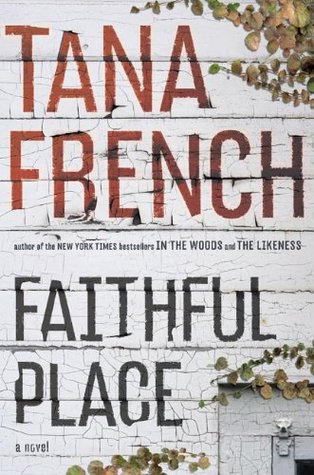
    • Book Review: “Faithful Place” by Tana French

      Posted at 4:23 pm by Laura, on June 3, 2012

      Faithful Place by Tana French

      Back in 1985, Frank Mackey was nineteen, growing up poor in Dublin’s inner city, and living crammed into a small flat with his family on Faithful Place. But he had his sights set on a lot more. He and Rosie Daly were all ready to run away to London together, get married, get good jobs, break away from factory work and poverty and their old lives.

      But on the winter night when they were supposed to leave, Rosie didn’t show. Frank took it for granted that she’d dumped him-probably because of his alcoholic father, nutcase mother, and generally dysfunctional family. He never went home again.

      Neither did Rosie. Everyone thought she had gone to England on her own and was over there living a shiny new life. Then, twenty-two years later, Rosie’s suitcase shows up behind a fireplace in a derelict house on Faithful Place, and Frank is going home whether he likes it or not.

      Getting sucked in is a lot easier than getting out again. Frank finds himself straight back in the dark tangle of relationships he left behind. The cops working the case want him out of the way, in case loyalty to his family and community makes him a liability. Faithful Place wants him out because he’s a detective now, and the Place has never liked cops. Frank just wants to find out what happened to Rosie Daly-and he’s willing to do whatever it takes, to himself or anyone else, to get the job done.

      This third installment of the Dublin Murder series was better than the first book (In the Woods) and not as fantastic as the second book (The Likeness). It is a mixture of the two, with personal dilemmas like the first and loads of intrigue and mystery like the second. Faithful Place is first and foremost a love story, discovering the past and revealing mysterious incidents through vengeance. Frank Mackey is quite the charmer, and stops at nothing to discover what happened to his old girlfriend (and later, his brother).

      Rather than taking place in offices and solving the mystery through crime lab results and scientific data, Frank discovers everything “old school.” He’s always at the scene of the crime, back home, or visiting old friends’ places and having multiple conversations with others. At first the conversations seemed to drag – I wondered what the point was for all the dialogue – but once it seemed to be too much, Frank (and the reader) could immediately make connections to other conversations and incidents from the past. Tana French was very clever in her subtle hints and twists in the plot.

      What was incredibly fascinating was the internal switch in my mental accent. The voice reading in my head was no longer a midwestern American, but an Irish voice that I’m sure was a terrible mimicry of a true Dublin accent. The slang, phrasing, and deliberate misspellings in the dialogue begged to be read with the accent in mind! It certainly became entertaining, and easier to read once I got the hang of it.

      Filled with intrigue, old-fashioned word-of-mouth mystery-solving, folklore, and Irish homeliness, I would recommend this book to anyone who deeply enjoyed The Likeness (which Frank makes repeated appearances in) or wants a good heartbreaking love story that ended in murder. The relationships between the characters are entertaining, the conversations and class divides interesting, and the atmosphere intoxicating.

      Rating: ★★★★★
      Goodreads: 3.89 of 5

      Posted in books, Reviews 2012 | 0 Comments | Tagged book review, books, genre: adult fiction, genre: fiction, genre: mystery, goodreads, review
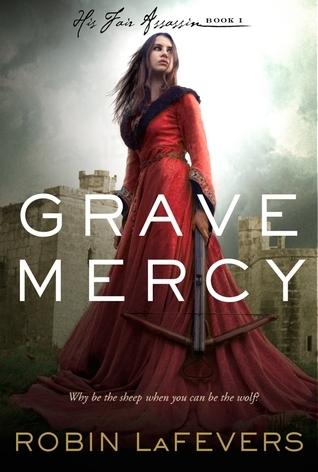
    • Book Review: “Grave Mercy” by Robin LaFevers

      Posted at 6:12 pm by Laura, on May 12, 2012

      Grave Mercy by Robin LaFevers

      Why be the sheep, when you can be the wolf?

      Seventeen-year-old Ismae escapes from the brutality of an arranged marriage into the sanctuary of the convent of St. Mortain, where the sisters still serve the gods of old. Here she learns that the god of Death Himself has blessed her with dangerous gifts—and a violent destiny. If she chooses to stay at the convent, she will be trained as an assassin and serve as a handmaiden to Death. To claim her new life, she must destroy the lives of others.

      Ismae’s most important assignment takes her straight into the high court of Brittany—where she finds herself woefully under prepared—not only for the deadly games of intrigue and treason, but for the impossible choices she must make. For how can she deliver Death’s vengeance upon a target who, against her will, has stolen her heart?

      I should start this review by saying I was not expecting too much from this novel. I bought it on my Nook because I liked the cover and the idea of historical fantasy / assassin nuns. However, I expected it to be extremely silly and a young adult version of a trashy romance novel, while also tossing in some royal political Philippa Gregory-style intrigue.

      Admittedly, there are moments when it becomes borderline trashy romance, but so much of the novel is taken up with character development, plots, mysteries, schemes, and politics of medieval/Renaissance Brittany that this can be overlooked. Gavriel Duval, the character who has “stolen Ismae’s heart” is a wonderfully complex character without any of those typical brooding descriptions. Ismae is a hard nut to crack, firmly stubborn, sometimes blind, and wildly bitter — and rightfully so.

      The historical time frame is a bit hazy, but if I knew more about weapons and poisons and the political history of Brittany I could narrow it down pretty well. LaFevers does an excellent job of describing historical artifacts and the different tricks courtiers are notorious for (having read The Courtier and The Prince for a Renaissance history class, it is clear LaFevers has done her research). The drawback for me as a reader is my lack of knowledge of Brittany. If I had known more about this little duchy, the century would have become more clear. Because of this hindrance, I had to suspend any disbelief I may have held in regards to historical context.

      The fantasy, however, is fantastic (ha!). I love the idea of combining old religions with Christianity, masking them with different names. Apparently there were 9 gods that ruled Brittany, later renamed as saints for the sake of the Church. Ismae’s is the god of Death, and not Death as we would understand it. At first we find Ismae misunderstanding her tasks as missions of vengeance, but she soon grows to understand (and become blessed by Death) that her mission is one of mercy.

      I read through this novel as quickly as I could between job interviews and visits to the vet for my poor cat – I’m sure if I had a full day to sit and be alone, this would have been plowed through in a few hours. I was drawn to the tale, for that’s what it is. A really good story – not of literary merit or praise or any such thing as that, but a tale of faith, death, and love in a time of political turmoil.

      Rating: ★★★ of 5
      Goodreads: 4.09 of 5

      Posted in books, Reviews 2012 | 0 Comments | Tagged book review, books, ebooks, genre: fantasy, genre: fiction, genre: history, genre: young adult, goodreads, review
    • Book Review: “Pandemonium” by Lauren Oliver

      Posted at 9:44 pm by Laura, on May 9, 2012

      Pandemonium by Lauren Oliver

      I’m pushing aside the memory of my nightmare,
      pushing aside thoughts of Alex,
      pushing aside thoughts of Hana and my old school,
      push,
      push,
      push,
      like Raven taught me to do.
      The old life is dead.
      But the old Lena is dead too.
      I buried her.
      I left her beyond a fence,
      behind a wall of smoke and flame.

      Once again, Oliver delivers a ride like none other. Unlike the first in her dystopian trilogy, Delirium, this second installment focuses on survival, growth, and rebellion rather than the discovery and immersion of love.

      The book is dividing into then and now to illustrate the development of Lena’s character. She describes herself as reborn in the Wilds, hardening with work, hunger, and violent weather. The thens are filled with survival tactics. Oliver delves into the pain of heartbreak and grief without becoming melodramatic.  The reader learns with Lena just how the people in the Wilds (or rather, “the other side”) live off remains and help from sympathizers. The nows jump to the future, almost a year after Lena’s escape, to her immersion back with the cureds in New York City. She works as a double agent of sorts, and falls into a trap, a scheme, that leads her to another boy, Julian.

      This is where the second book fell short of five stars and suffered the Middle Book Syndrome. Of course, because it’s YA and dystopian, there needs to be a love triangle. Sure. Fine. And maybe, realistically, this would happen to Lena if she truly believes Alex is dead. Even still, the romance seemed forced, far too rushed considering the time frame in the now lasted roughly two weeks at most. However, it certainly sets up for an explosive ending in the third book: politics, the definitive rise of rebellions, plus a little love war in the midst of it all.

      I’m really looking forward to Oliver’s next installment in the Delirium trilogy!

      Rating: ★★★★ of 5
      Goodreads: 4.25 of 5

      I am now over halfway completed with my 50 Books Challenge!

      Posted in books, Reviews 2012 | 0 Comments | Tagged 50 book challenge, book review, books, genre: dystopian, genre: fiction, genre: young adult, review
    • Book Review: “Delirium” by Lauren Oliver

      Posted at 4:29 pm by Laura, on April 27, 2012

      Delirium by Lauren Oliver

      Before scientists found the cure, people thought love was a good thing. They didn’t understand that once love — the deliria — blooms in your blood, there is no escaping its hold. Things are different now. Scientists are able to eradicate love, and the government demands that all citizens receive the cure upon turning eighteen. Lena Holoway has always looked forward to the day when she’ll be cured. A life without love is a life without pain: safe, measured, predictable, and happy.

      But with ninety-five days left until her treatment, Lena does the unthinkable: She falls in love.

      Thank heavens the second of this trilogy is already out! The massive and thrilling cliff-hanger at the end is too much to bear!

      This YA dystopian novel is the first book of the Delirium trilogy. It’s important to note that this is primarily a love story that takes place within a dystopian world, not a dystopian world with a love story (like Hunger Games).

      While love stories can become cheesy, this one most definitely did not. The desperation between Lena and Alex is real, solid, and threatening within their world. The US is the only nation with “the cure” and it is separated from the rest of the world, keeping the “cureds” within and the “infected” outside. Even the cities are locked within electric fences, preventing people from escaping into the Wilds, the area where all the Invalids (uncured or infected) inhabit.

      I found two things that really pulled me into and through the story: Lena’s transformation and enlightenment, as well as Oliver’s language. Lena is a perfectly rational, calm girl, awaiting the day of her surgery to become cured of the disease amor deliria nervosa. The rational behind the dangers of love make some sense: the pain, the drastic behaviors, sweating palms and strange appetites. These are all things people in love experience, but the world twists it in a negative way, causing everyone to fear love and fear those in love. By the end of the novel, she feels “alive” and “awakened,” wanting desperately to escape to the Wilds with Alex so she’ll never have to undergo the procedure. Her transformation is an adventure in its own right.

      The language – my goodness! It’s so beautiful. Although this novel is for young adult readers, Oliver does not underestimate her audience’s reading abilities. The language reads like adult novels, full of elegant descriptions and fantastic imagery and sensory detail. You become Lena, you experience everything she experiences, your heart pounds in fear, anxiety, and thrill when hers does.

      I like to also offer my two cents on social commentary. Oliver says she was inspired by Gabriel Garcia Marquez’s quote that great books are about love or death. While this is incredibly interesting and I love her take on it, I think there’s more that can be said. Suzanne Collins was inspired by wars and the media to write Hunger Games – the political commentary on that is immense. I think Delirium could also be a commentary on what modern society deems as acceptable love and human rights. Today, only a man and woman can marry. But there are also taboos within this freedom: younger men marrying older women, young girls marrying men the age of their grandparents, people marrying “too young” or marrying because of pregnancy. But this also does not leave room for men to marry men, women to marry women. Our society scoffs at teenagers who say they are in love — “You don’t know what real love is, you’re only 14.” We should take a step back and ask ourselves…whatis love? And why do we have such social pressures and regulations on what we believe is love?

      Food for thought.

      Rating: ★★★★★ of 5
      Goodreads: 4.6 of 5

      Posted in books, Reviews 2012 | 0 Comments | Tagged book review, books, genre: dystopian, genre: fiction, genre: romance, genre: young adult, review
    • Book Review: “Mockingjay” by Suzanne Collins

      Posted at 8:52 am by Laura, on April 22, 2012

      Mockingjay by Suzanne Collins

      Katniss Everdeen has survived the Hunger Games twice. But she’s still not safe. A Revolution is unfolding, and everyone, it seems, has had a hand in the carefully laid plans – everyone except Katniss.

      And yet she must play the most vital part in the final battle. Katniss must become their Mockingjay – the symbol of rebellion – no matter what the personal cost.

      Before I begin my review, I should warn any new readers to take this third book slowly. The first time I read it, it was finished in a day and I was left angry and riled up. The war, trauma, and conflicting emotions heighten the tension and despair. It’s vastly different from the previous two, and there’s a very good reason (which I’ll explain later). I read this again slowly, and found I enjoyed it much more and I was able to process everything much more easily.

      Spoilers ahead!

      Katniss and Peeta have been separated, and now it’s Gale’s time to shine. He’s very aggressive and forward in his decisions about the rebellion, which intimidates Katniss at first. In Chapter 7, when they visit District 8 and are attacked by the Capitol, Katniss has only one motivation for the rest of the story: to kill President Snow.

      She is traumatized and hospitalized more than I can count in this novel. With each visit, she deteriorates more and more. Most people have been bothered by the way the narrative changes with her mentality – but I will instead applaud Collins for accurately portraying a victim of post-traumatic stress disorder (PTSD). It is difficult for Katniss to function in “normal” society, but the second she enters combat she focuses on her motivation. Peeta experiences PTSD as well, and an advanced form of brainwashing. These two are stripped to their most basic personalities by the end of the novel – broken but attempting to heal, each helping the other to survive in a world without the Games.

      Beloved characters die, violence dominates the storyline, and political agendas twist the plot with each chapter. The readers experience every devastation with Katniss, who takes a speedy journey from a self-preserving teenager to a sacrificing, damaged adult.

      Rating: ★★★★ of 5
      Goodreads: 4.8 of 5

      Posted in books, Reviews 2012 | 0 Comments | Tagged book review, books, genre: dystopian, genre: fiction, genre: young adult, goodreads
    ← Older posts
    Newer posts →
    • Hello, I’m Laura!

      I'm a bookish bookworm and book hoarder. By day I'm a literary agent, and by night I'm forever rearranging my bookshelves. I could talk your ear off about Gothic literature, and in my past life people thought I'd become a professional musician. I have a fluffy black cat named Rossetti, I love to travel, tea is my drink of choice, British TV is the best, and I'm always down for chips-and-queso nights. Welcome to Scribbles & Wanderlust! Grab your favorite hot beverage and let's chat books!
    • Search the Blog

    • Currently Reading

    • Book Review Rating Key

      ★★★ — It’s good
      ★★★★ — It’s great
      ★★★★★ — OMG LOVE!!!

    • Recent Posts

      • MSWL for 2026
      • Favorite Reads of 2025
      • Deal Announcement: Nina Moreno, YA Romance
      • Deal Announcement: Sharon Choe, YA Fantasy
      • Deal Announcement: Hanna R. Neier, MG Historical/Contemporary

Blog at WordPress.com.

Scribbles & Wanderlust
Blog at WordPress.com.
  • Subscribe Subscribed
    • Scribbles & Wanderlust
    • Join 1,203 other subscribers
    • Already have a WordPress.com account? Log in now.
    • Scribbles & Wanderlust
    • Subscribe Subscribed
    • Sign up
    • Log in
    • Report this content
    • View site in Reader
    • Manage subscriptions
    • Collapse this bar
 

Loading Comments...